Effects of the combined administration of vitamin C and quercetin on urea and creatinine levels, histopathological features in ethanol-induced mice
DOI:
https://doi.org/10.70347/svsthya.v3i6.143Keywords:
Antioxidant, ethanol, kidney injury, Quercetin, renoprotection, vitamin CAbstract
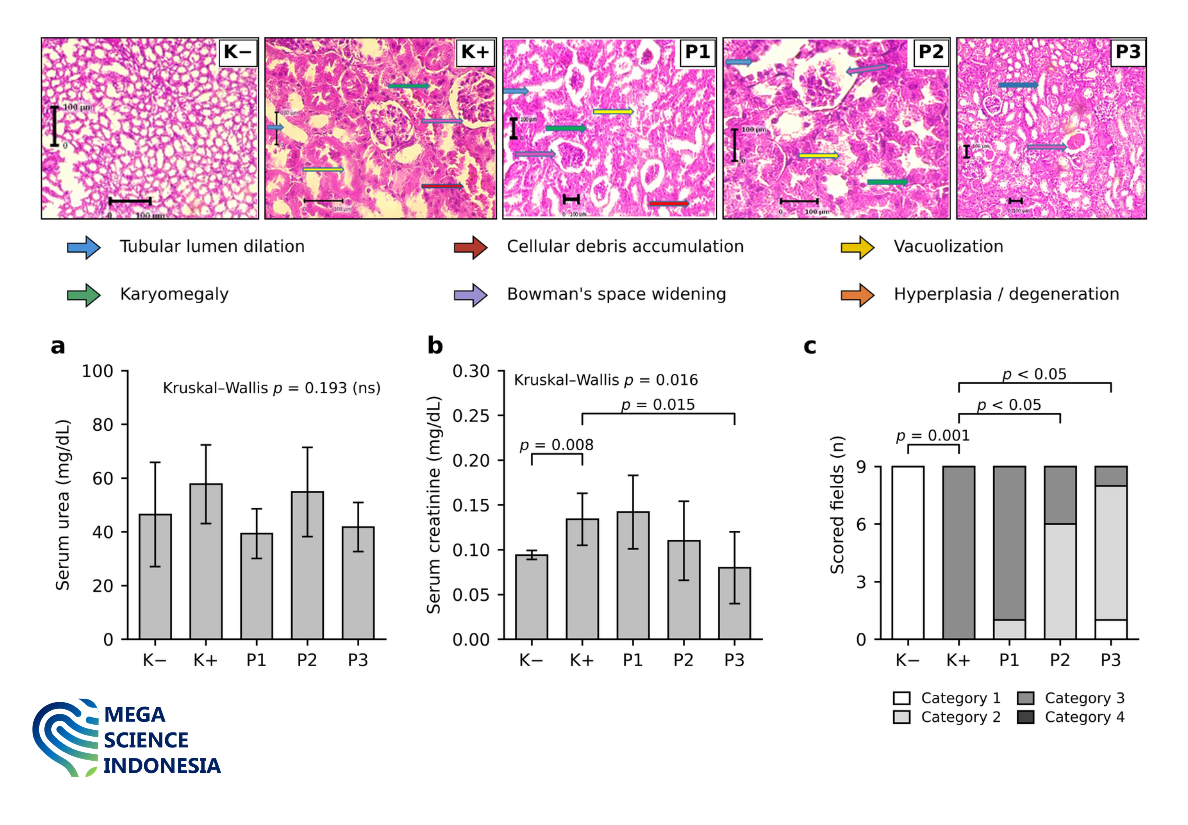
During ethanol metabolism, the generation of reactive oxygen species (ROS) can alter the structure and function of several organs, including the kidney. Serum urea and creatinine levels are routinely used to assess kidney function, and histopathological examination of renal tissue provides complementary information on structural injury. Vitamin C and quercetin possess antioxidant activity that may limit ethanol-induced renal injury. This study aimed to evaluate whether the combined administration of vitamin C and quercetin attenuates ethanol-induced changes in serum urea levels, serum creatinine levels, and renal histopathology in mice. A posttest-only control group design was applied to 30 male Swiss Webster mice randomly allocated to five groups of six animals: a negative control (K−); a positive control receiving 4 mL/kg body weight of ethanol (K+); and three groups receiving ethanol together with vitamin C and quercetin at 50 and 20 mg/kg (P1), 100 and 40 mg/kg (P2), and 200 and 80 mg/kg body weight (P3). After 28 days, serum urea and creatinine levels were measured, and the kidneys were processed for hematoxylin–eosin staining and semiquantitative scoring. Data were analyzed using the Kruskal–Wallis test followed by pairwise Mann–Whitney comparisons. Serum urea levels did not differ significantly between groups (Kruskal–Wallis p = 0.193). Serum creatinine levels differed significantly (p = 0.016): they were higher in K+ than in K− (p = 0.008) and lower in P3 than in K+ (p = 0.015). Histopathological scores also differed significantly (p < 0.01), with lower scores in P2 and P3 than in K+ (p < 0.05). The combination of vitamin C and quercetin attenuated the ethanol-associated increase in serum creatinine levels and the severity of renal histopathological injury, with the clearest effect observed at vitamin C concentrations of 200 mg/kg and 80 mg/kg.
Downloads
References
Sandoval C, Vásquez B, Mandarim-de-Lacerda C, del Sol M. Ethanol intake and toxicity: in search of new treatments. Int J Morphol 2017;35:942–9. https://doi.org/10.4067/S0717-95022017000300024 DOI: https://doi.org/10.4067/S0717-95022017000300024
Kusumawardani N, Wiryawan Y, Anwar A, Handayani K, Angraeni S. Perilaku berisiko kesehatan pada pelajar SMP dan SMA di Indonesia. Jakarta: Badan Litbangkes Kementerian Kesehatan RI; 2016. https://cdn.who.int/media/docs/default-source/ncds/ncd-surveillance/data-reporting/indonesia/gshs/gshs-2015-indonesia-report-bahasa.pdf?sfvrsn=eb05c71c_2&download=true (accessed 28 April 2025).
Varga ZV, Matyas C, Paloczi J, Pacher P. Alcohol misuse and kidney injury: epidemiological evidence and potential mechanisms. Alcohol Res 2017;38:283–8. DOI: https://doi.org/10.35946/arcr.v38.2.10
Yanardag R, Ozsoy-Sacan O, Ozdil S, Bolkent S. Combined effects of vitamin C, vitamin E, and sodium selenate supplementation on absolute ethanol-induced injury in various organs of rats. Int J Toxicol 2007;26:513–23. https://doi.org/10.1080/10915810701707296 DOI: https://doi.org/10.1080/10915810701707296
Padayatty SJ, Levine M. Vitamin C: the known and the unknown and Goldilocks. Oral Dis 2016;22:463–93. https://doi.org/10.1111/odi.12446 DOI: https://doi.org/10.1111/odi.12446
Arifin B, Ibrahim S. Struktur, bioaktivitas dan antioksidan flavonoid. J Zarah 2018;6. https://doi.org/10.31629/zarah.v6i1.313 DOI: https://doi.org/10.31629/zarah.v6i1.313
Purbayanti D. Efek konsumsi minuman beralkohol terhadap kadar kreatinin. J Surya Med 2018;4:44–50. https://doi.org/10.33084/jsm.v4i1.349 DOI: https://doi.org/10.33084/jsm.v4i1.349
Paunović MG, Ognjanović BI, Matić MM, Štajn AŠ, Saičić ZS. Protective effects of quercetin and vitamin C against nicotine-induced toxicity in the blood of Wistar rats. Arh Hig Rada Toksikol 2016;67:304–10. https://doi.org/10.1515/aiht-2016-67-2795 DOI: https://doi.org/10.1515/aiht-2016-67-2795
Gomes IBS, Porto ML, Santos MCLFS, Campagnaro BP, Pereira TMC, Meyrelles SS, et al. Renoprotective, antioxidative and anti-apoptotic effects of oral low-dose quercetin in the C57BL/6J model of diabetic nephropathy. Lipids Health Dis 2014;13:184. https://doi.org/10.1186/1476-511X-13-184 DOI: https://doi.org/10.1186/1476-511X-13-184
Shebeko SK, Zupanets IA, Propisnova VV. N-acetylglucosamine increases the efficacy of quercetin in the treatment of experimental acute kidney injury. J Pharm Pharmacogn Res 2020;8. https://doi.org/10.56499/jppres19.689_8.1.53 DOI: https://doi.org/10.56499/jppres19.689_8.1.53
Zal F, Mostafavi-Pour Z, Vessal M. Comparison of the effects of vitamin E and/or quercetin in attenuating chronic cyclosporine A-induced nephrotoxicity in male rats. Clin Exp Pharmacol Physiol 2007;34:720–4. https://doi.org/10.1111/j.1440-1681.2007.04623.x DOI: https://doi.org/10.1111/j.1440-1681.2007.04623.x
Bandiera S, Pulcinelli RR, Huf F, Almeida FB, Halmenschlager G, Bitencourt PER, et al. Hepatic and renal damage by alcohol and cigarette smoking in rats. Toxicol Res 2021;37:209–19. https://doi.org/10.1007/s43188-020-00057-y DOI: https://doi.org/10.1007/s43188-020-00057-y
Hasanah U. Penentuan kadar vitamin C pada mangga kweni dengan menggunakan metode iodometri. J Kel Sehat Sejah 2018;16:90–5. https://doi.org/10.24114/jkss.v16i31.10176 DOI: https://doi.org/10.24114/jkss.v16i31.10176
Primadevi S, Kresnadipayana D. Penetapan kadar etanol pada minuman beralkohol berbagai merk melalui pengukuran berat jenis. Biomedika 2016;9.
Percie du Sert N, Hurst V, Ahluwalia A, Alam S, Avey MT, Baker M, et al. The ARRIVE guidelines 2.0: updated guidelines for reporting animal research. PLoS Biol 2020;18:e3000410. https://doi.org/10.1371/journal.pbio.3000410 DOI: https://doi.org/10.1371/journal.pbio.3000410
Qodar TS. Efek pemberian tepung kedelai (Glycine max (L.) Merr.) sebagai nefroprotektor terhadap gambaran histopatologi ginjal tikus Wistar jantan yang diinduksi diazinon [undergraduate thesis]. Jember: Universitas Jember; 2018. DOI: https://doi.org/10.23886/ejki.7.10287.
Trimawartinah T. Bahan ajar statistik non parametrik. 2020.
Ostertagova E, Ostertag O, Kováč J. Methodology and application of the Kruskal‒Wallis test. Appl Mech Mater 2014;611:115–20. https://doi.org/10.4028/www.scientific.net/AMM.611.115 DOI: https://doi.org/10.4028/www.scientific.net/AMM.611.115
Das SK, Varadhan S, Dhanya L, Mukherjee S, Vasudevan DM. Effects of chronic ethanol exposure on renal function tests and oxidative stress in kidney. Indian J Clin Biochem 2008;23:341–4. https://doi.org/10.1007/s12291-008-0075-6 DOI: https://doi.org/10.1007/s12291-008-0075-6
Gounden V, Bhatt H, Jialal I. Renal function tests. In: StatPearls. Treasure Island (FL): StatPearls Publishing; 2023. https://www.ncbi.nlm.nih.gov/books/NBK507821/ (accessed 28 April 2025).
Akinloye DI, Ugbaja RN, Dosumu OA, Rahman SA, Ugwor EI, James AS, et al. A time course study on dose‒response relationship between alcohol exposure and its effects on lipid profile and biomarkers of tissue damage. Biochem Biophys Rep 2021;26:100927. https://doi.org/10.1016/j.bbrep.2021.100927 DOI: https://doi.org/10.1016/j.bbrep.2021.100927
Cederbaum AI. Alcohol metabolism. Clin Liver Dis 2012;16:667–85. https://doi.org/10.1016/j.cld.2012.08.002 DOI: https://doi.org/10.1016/j.cld.2012.08.002
Latchoumycandane C, Nagy LE, McIntyre TM. Chronic ethanol ingestion induces oxidative kidney injury through taurine-inhibitable inflammation. Free Radic Biol Med 2014;69:403–16. https://doi.org/10.1016/j.freeradbiomed.2014.01.001 DOI: https://doi.org/10.1016/j.freeradbiomed.2014.01.001
Elnagar GM, Elseweidy MM, Elkomy NMIM, Al-Gabri NA, Shawky M. 10-Dehydrogingerdione ameliorates renal endoplasmic reticulum/oxidative stress and apoptosis in alcoholic nephropathy induced in experimental rats. Life Sci 2021;279:119673. https://doi.org/10.1016/j.lfs.2021.119673 DOI: https://doi.org/10.1016/j.lfs.2021.119673
Latchoumycandane C, Nagy LE, McIntyre TM. Myeloperoxidase formation of PAF receptor ligands induces PAF receptor-dependent kidney injury during ethanol consumption. Free Radic Biol Med 2015;86:179–90. https://doi.org/10.1016/j.freeradbiomed.2015.05.020 DOI: https://doi.org/10.1016/j.freeradbiomed.2015.05.020
Li Y, Yao J, Han C, Yang J, Chaudhry MT, Wang S, et al. Quercetin, inflammation and immunity. Nutrients 2016;8:167. https://doi.org/10.3390/nu8030167 DOI: https://doi.org/10.3390/nu8030167
Yudhisthira NL, Rahaju AS, Mustika A. Renal histopathology after mixed liquor consumption in Wistar rat. GSC Biol Pharm Sci 2022;20:324–9. https://doi.org/10.30574/gscbps.2022.20.3.0354 DOI: https://doi.org/10.30574/gscbps.2022.20.3.0354
Downloads
Published
How to Cite
Issue
Section
License
Copyright (c) 2026 Hermansyah Salwa Arastech, Nabil Hajar, Lukman Faishal Fatharani, Bela Bagus Setiawan (Author)

This work is licensed under a Creative Commons Attribution-NonCommercial-NoDerivatives 4.0 International License.
This license enables reusers to copy and distribute the material in any medium or format in unadapted form only, for noncommercial purposes only, and only so long as attribution is given to the creator.