Epidemiology of tuberculosis in Aceh, Indonesia, 2016–2021: an ecological study of regional surveillance data
DOI:
https://doi.org/10.70347/svsthya.v3i6.164Keywords:
Tuberculosis, Epidemiology, public health surveillance, spatial analysis, case fatality, IndonesiaAbstract
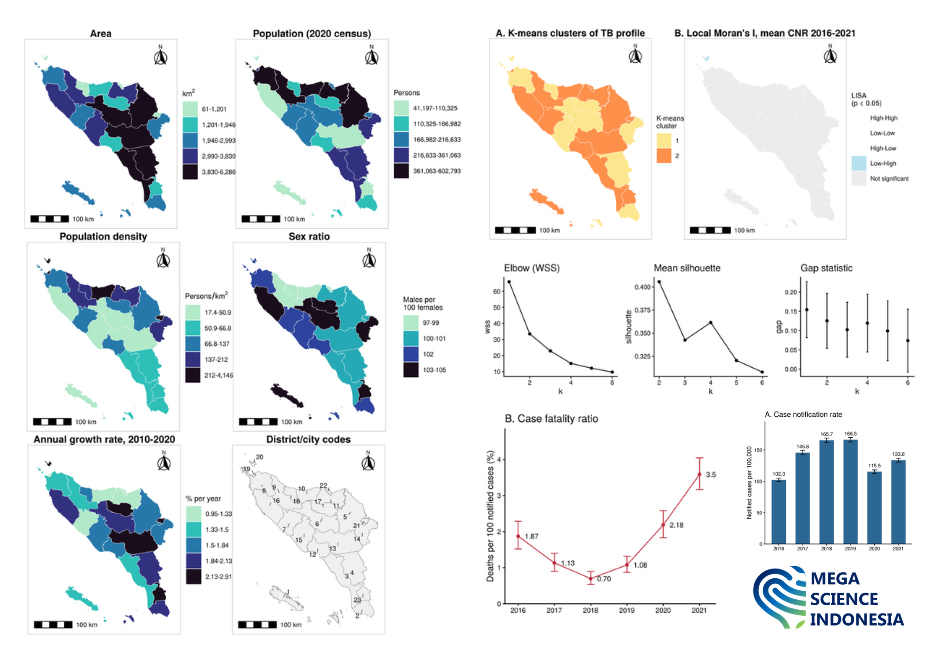
Aceh Province reported the lowest tuberculosis (TB) treatment coverage in Indonesia in 2020; however, the distribution of TB across its 23 districts and cities has not been described using spatial methods. To describe the temporal and spatial distributions of TB notifications, case fatalities, and treatment outcomes in Aceh from 2016–2021 and to explore their ecological associations with district demographic characteristics. This ecological study used aggregated annual district-level data from the Aceh Provincial Health. Case notification rates (CNRs) and case fatality ratios (CFRs) were analyzed using negative binomial mixed models. Associations with population density, growth rate, and sex ratio were explored using Spearman correlation and negative binomial regression. Districts were grouped using K-means clustering, and spatial autocorrelation was assessed using global and local Moran’s I. Notifications rose in 2016 to 2019, decreased by 30.7% in 2020, and recovered only partly in 2021 (133.8). The CFR increased from 1.08% in 2019 to 2.18% in 2020 and 3.58% in 2021, a 3.3-fold increase relative to the 2016–2019 rate. Treatment success reached 90% only in 2016 and 2017, whereas the cure rate decreased from 80% to 30%. No demographic covariates showed a consistent association with the CNR. The cluster structure was weak (mean silhouette = 0.41). The global Moran’s I was negative (−0.35; p = 0.039), reflecting high-CNR cities surrounded by lower-CNR regions, and this pattern was not robust to an alternative neighborhood definition. The TB in Aceh showed an urban-enclave pattern without contiguous hotspots. Restoring active case findings and bacteriological follow-up and improving the quality of district surveillance data should be priorities for TB elimination in Aceh.
Downloads
References
Utomo B, Chan CK, Mertaniasih NM, Soedarsono S, Fauziyah S, Sucipto TH, et al. Comparison epidemiology between tuberculosis and COVID-19 in East Java Province, Indonesia: an analysis of regional surveillance data in 2020. Trop Med Infect Dis 2022;7:83. https://doi.org/10.3390/tropicalmed7060083. DOI: https://doi.org/10.3390/tropicalmed7060083
World Health Organization. Tuberculosis. Geneva: WHO; 2021. https://www.who.int/health-topics/tuberculosis#tab=tab_1.
Eljatin DS, Akbar Eljatin MR, Mertha Adnyana IMD, Hutagalung MBZ, Setyawan MF. Excessive use of nipah leaf membrane cigarettes increases the severity of spontaneous pneumothorax: a case study from Jambi, Indonesia. J Pharm Health Res 2023;4:9–13. https://doi.org/10.47065/jharma.v4i1.2820. DOI: https://doi.org/10.47065/jharma.v4i1.2820
Lönnroth K, Jaramillo E, Williams BG, Dye C, Raviglione M. Drivers of tuberculosis epidemics: the role of risk factors and social determinants. Soc Sci Med 2009;68:2240–6. https://doi.org/10.1016/j.socscimed.2009.03.041. DOI: https://doi.org/10.1016/j.socscimed.2009.03.041
World Health Organization. Global tuberculosis report 2019. Geneva: WHO; 2019. https://www.who.int/publications/i/item/9789241565714. Accessed: 13 Sep 2022.
World Health Organization. Global tuberculosis report 2022. Geneva: WHO; 2022. https://www.who.int/publications/i/item/9789240061729.
Winardi W, Wahyuni H, Hidayat M, Wirawan A, Nurwidya F, Uddin MN, et al. Challenges on tuberculosis care in health care facilities during COVID-19 pandemic: Indonesian perspective. Narra J 2022;2:e80. https://doi.org/10.52225/narra.v2i2.80. DOI: https://doi.org/10.52225/narra.v2i2.80
World Health Organization. Weekly epidemiological update on COVID-19, 23 November 2022. Geneva: WHO; 2022. https://www.who.int/publications/m/item/weekly epidemiological-update-on-covid-19---23-November-2022. Accessed: 25 Nov 2022.
Kementerian Kesehatan Republik Indonesia. Profil Kesehatan Indonesia 2020. Jakarta: Kementerian Kesehatan Republik Indonesia; 2021.
World Health Organization. Global tuberculosis report 2021. Geneva: WHO; 2021. https://www.who.int/publications/i/item/9789240037021.
Noviyani A, Nopsopon T, Pongpirul K. Variation of tuberculosis prevalence across diagnostic approaches and geographical areas of Indonesia. PLoS One 2021;16:e0258809. https://doi.org/10.1371/journal.pone.0258809. DOI: https://doi.org/10.1371/journal.pone.0258809
Nur A, Ichwansyah F, Srioetami F, Mahdani W, Handayani S, Ekowatiningsih R, et al. Gambaran penderita tuberculosis paru di Kota Banda Aceh dan Kabupaten Aceh Besar. Jakarta: Kementerian Kesehatan Republik Indonesia; 2018.
Patra K, Batabyal S, Mandal K, Ghose D, Sarkar J. Tuberculosis and COVID-19: a combined global threat to human civilization. Clin Epidemiol Glob Health 2022;15:101031. https://doi.org/10.1016/j.cegh.2022.101031. DOI: https://doi.org/10.1016/j.cegh.2022.101031
Zimmer AJ, Klinton JS, Oga-Omenka C, Heitkamp P, Nawina Nyirenda C, Furin J, et al. Tuberculosis in times of COVID-19. J Epidemiol Community Health 2022;76:310–6. https://doi.org/10.1136/jech-2021-217529. DOI: https://doi.org/10.1136/jech-2021-217529
Wang Q, Guo S, Wei X, Dong Q, Xu N, Li H, et al. Global prevalence, treatment and outcome of tuberculosis and COVID-19 coinfection: a systematic review and meta-analysis (from November 2019 to March 2021). BMJ Open 2022;12:e059396. https://doi.org/10.1136/bmjopen-2021-059396. DOI: https://doi.org/10.1136/bmjopen-2021-059396
Muhrer JC. Risk of misdiagnosis and delayed diagnosis with COVID-19: a syndemic approach. Nurse Pract 2021;46:44–9. https://doi.org/10.1097/01.NPR.0000731572.91985.98. DOI: https://doi.org/10.1097/01.NPR.0000731572.91985.98
Bray L, Meznikova K, James D, Rislan R, Shah R, Mason P, et al. Misdiagnoses in the context of suspected pandemic influenza or coronavirus disease 2019: a systematic review. Open Forum Infect Dis 2022;9:ofac515. https://doi.org/10.1093/ofid/ofac515. DOI: https://doi.org/10.1093/ofid/ofac515
Mishra A, George AA, Sahu KK, Lal A, Abraham G. Tuberculosis and COVID-19 coinfection: an updated review. Acta Biomed 2020;92:e2021025. https://doi.org/10.23750/abm.v92i1.10738.
Celebi Congur E, Dalgic N, Ada HI, Türksoy F, Yıldırmak ZY. Diagnostic challenges during the COVID-19 pandemic: a child with tuberculosis-induced hemophagocytic lymphohistiocytosis misdiagnosed as multi-inflammatory syndrome in children. J Paediatr Child Health 2022;58:2305–7. https://doi.org/10.1111/jpc.16160. DOI: https://doi.org/10.1111/jpc.16160
Awan HA, Sahito AM, Sukaina M, Khatri G, Waheed S, Sohail F, et al. Tuberculosis amidst COVID-19 in Pakistan: a massive threat of overlapping crises for the fragile healthcare systems. Epidemiol Infect 2022;150:e41. https://doi.org/10.1017/S0950268822000358. DOI: https://doi.org/10.1017/S0950268822000358
Amirullah, Tosepu R, Effendy DS. Epidemiology of tuberculosis disease using surveillance data in Kendari City, Indonesia. KnE Life Sci 2022:63–7. https://doi.org/10.18502/kls.v0i0.11774. DOI: https://doi.org/10.18502/kls.v0i0.11774
Fahdhienie F, Sitepu FY. Spatiotemporal analysis of tuberculosis incidence in North Aceh District, Indonesia 2019–2021. Geospat Health 2022;17:1148. https://doi.org/10.4081/gh.2022.1148. DOI: https://doi.org/10.4081/gh.2022.1148
Adnyana IMDM. Populasi dan sampel. In: Metode penelitian pendekatan kuantitatif. Bandung: CV Media Sains Indonesia; 2021, p. 103–16.
Benchimol EI, Smeeth L, Guttmann A, Harron K, Moher D, Petersen I, et al. The REporting of studies Conducted using Observational Routinely collected health Data (RECORD) statement. PLoS Med 2015;12:e1001885. https://doi.org/10.1371/journal.pmed.1001885. DOI: https://doi.org/10.1371/journal.pmed.1001885
Badan Pusat Statistik Provinsi Aceh. Provinsi Aceh dalam angka 2022 (Aceh Province in figures 2022). Banda Aceh: BPS Provinsi Aceh; 2022.
Badan Informasi Geospasial. Batas wilayah administrasi kabupaten/kota skala 1:50.000 (TASWIL5000020220921). Cibinong: Badan Informasi Geospasial; 2022.
World Health Organization. Definitions and reporting framework for tuberculosis – 2013 revision (updated December 2014 and January 2020). Geneva: WHO; 2013. https://www.who.int/publications/i/item/9789241505345.
National Institute for Health and Care Excellence. Tuberculosis (NICE guideline NG33). London: NICE; 2016. https://www.nice.org.uk/guidance/ng33.
World Health Organization. Implementing the End TB Strategy: the essentials. Geneva: WHO; 2015. https://www.who.int/publications/i/item/9789241509930.
R Core Team. R: a language and environment for statistical computing. Version 4.3.3. Vienna: R Foundation for Statistical Computing; 2024. https://www.R-project.org/.
Brooks ME, Kristensen K, van Benthem KJ, Magnusson A, Berg CW, Nielsen A, et al. glmmTMB balances speed and flexibility among packages for zero-inflated generalized linear mixed modeling. R J 2017;9:378–400. https://doi.org/10.32614/RJ-2017-066. DOI: https://doi.org/10.32614/RJ-2017-066
Hartig F. DHARMa: residual diagnostics for hierarchical (multilevel/mixed) regression models. R package version 0.5.1. 2025. https://CRAN.R-project.org/package=DHARMa.
Darwin M, Mamondol MR, Sormin SA, Nurhayati Y, Tambunan H, Sylvia D, et al. Metode penelitian pendekatan kuantitatif. 1st ed. Bandung: CV Media Sains Indonesia; 2021.
Hartigan JA, Wong MA. Algorithm AS 136: a K-means clustering algorithm. J R Stat Soc Ser C Appl Stat 1979;28:100–8. https://doi.org/10.2307/2346830. DOI: https://doi.org/10.2307/2346830
Rousseeuw PJ. Silhouettes: a graphical aid to the interpretation and validation of cluster analysis. J Comput Appl Math 1987;20:53–65. https://doi.org/10.1016/0377-0427(87)90125-7. DOI: https://doi.org/10.1016/0377-0427(87)90125-7
Tibshirani R, Walther G, Hastie T. Estimating the number of clusters in a dataset via the gap statistic. J R Stat Soc Series B Stat Methodol 2001;63:411–23. https://doi.org/10.1111/1467-9868.00293. DOI: https://doi.org/10.1111/1467-9868.00293
Moran PAP. Notes on continuous stochastic phenomena. Biometrika 1950;37:17–23. https://doi.org/10.1093/biomet/37.1-2.17. DOI: https://doi.org/10.1093/biomet/37.1-2.17
Assunção RM, Reis EA. A new proposal to adjust Moran’s I for population density. Stat Med 1999;18:2147–62. https://doi.org/10.1002/(SICI)1097-0258(19990830)18:16<2147::AID-SIM179>3.0.CO;2-I. DOI: https://doi.org/10.1002/(SICI)1097-0258(19990830)18:16<2147::AID-SIM179>3.0.CO;2-I
Anselin L. Local indicators of spatial association—LISA. Geogr Anal 1995;27:93–115. https://doi.org/10.1111/j.1538-4632.1995.tb00338.x. DOI: https://doi.org/10.1111/j.1538-4632.1995.tb00338.x
Ord JK, Getis A. Local spatial autocorrelation statistics: distributional issues and an application. Geogr Anal 1995;27:286–306. https://doi.org/10.1111/j.1538-4632.1995.tb00912.x. DOI: https://doi.org/10.1111/j.1538-4632.1995.tb00912.x
Bivand RS, Wong DWS. Comparing implementations of global and local indicators of spatial association. TEST 2018;27:716–48. https://doi.org/10.1007/s11749-018-0599-x. DOI: https://doi.org/10.1007/s11749-018-0599-x
Pebesma E. Simple features for R: standardized support for spatial vector data. R J 2018;10:439–46. https://doi.org/10.32614/RJ-2018-009. DOI: https://doi.org/10.32614/RJ-2018-009
United States Agency for International Development. Indonesia TB recovery plan to mitigate the impact of COVID-19. Washington DC: USAID; 2021. https://www.usaid.gov/sites/default/files/documents/Recovery_Plan_Indonesia_FINAL-remediated.pdf.
Bhatia V, Mandal PP, Satyanarayana S, Aditama TY, Sharma M. Mitigating the impact of the COVID-19 pandemic on progress toward ending tuberculosis in the WHO South‒East Asia Region. WHO South East Asia J Public Health 2020;9:95–9. https://doi.org/10.4103/2224-3151.294300. DOI: https://doi.org/10.4103/2224-3151.294300
Soko RN, Burke RM, Feasey HRA, Sibande W, Nliwasa M, Henrion MYR, et al. Effects of coronavirus disease pandemic on tuberculosis notifications, Malawi. Emerg Infect Dis 2021;27:1831–9. https://doi.org/10.3201/eid2707.210557. DOI: https://doi.org/10.3201/eid2707.210557
Behera D. TB control in India in the COVID era. Indian J Tuberc 2021;68:128–33. https://doi.org/10.1016/j.ijtb.2020.08.019. DOI: https://doi.org/10.1016/j.ijtb.2020.08.019
Pai M, Kasaeva T, Swaminathan S. Covid-19’s devastating effect on tuberculosis care — a path to recovery. N Engl J Med 2022;386:1490–3. https://doi.org/10.1056/NEJMp2118145. DOI: https://doi.org/10.1056/NEJMp2118145
Mertha Adnyana IMD, Azhari FSS, Sudaryati NLG. Prevalence of dengue hemorrhagic fever in Bali from 2015 to 2020 and during the COVID-19 pandemic. J Berk Epidemiol 2022;10:169–78. https://doi.org/10.20473/jbe.v10i22022.169-178. DOI: https://doi.org/10.20473/jbe.V10I22022.169-178
Visca D, Ong CWM, Tiberi S, Centis R, D’Ambrosio L, Chen B, et al. Tuberculosis and COVID-19 interaction: a review of biological, clinical and public health effects. Pulmonology 2021;27:151–65. https://doi.org/10.1016/j.pulmoe.2020.12.012. DOI: https://doi.org/10.1016/j.pulmoe.2020.12.012
Petrone L, Petruccioli E, Vanini V, Cuzzi G, Gualano G, Vittozzi P, et al. Coinfection of tuberculosis and COVID-19 limits the ability to in vitro respond to SARS-CoV-2. Int J Infect Dis 2021;113 Suppl 1:S82–7. https://doi.org/10.1016/j.ijid.2021.02.090. DOI: https://doi.org/10.1016/j.ijid.2021.02.090
Sy KTL, Haw NJL, Uy J. Previous and active tuberculosis increases risk of death and prolongs recovery in patients with COVID-19. Infect Dis (Lond) 2020;52:902–7. https://doi.org/10.1080/23744235.2020.1806353. DOI: https://doi.org/10.1080/23744235.2020.1806353
Trajman A, Felker I, Alves LC, Coutinho I, Osman M, Meehan SA, et al. The COVID-19 and TB syndemic: the way forward. Int J Tuberc Lung Dis 2022;26:710–9. https://doi.org/10.5588/ijtld.22.0006. DOI: https://doi.org/10.5588/ijtld.22.0006
TB/COVID-19 Global Study Group. Tuberculosis and COVID-19 coinfection: description of the global cohort. Eur Respir J 2022;59:2102538. https://doi.org/10.1183/13993003.02538-2021. DOI: https://doi.org/10.1183/13993003.02538-2021
Song W, Zhao J, Zhang Q, Liu S, Zhu X, An Q, et al. COVID-19 and tuberculosis coinfection: an overview of case reports/case series and meta-analysis. Front Med (Lausanne) 2021;8:657006. https://doi.org/10.3389/fmed.2021.657006. DOI: https://doi.org/10.3389/fmed.2021.657006
Sereda Y, Korotych O, Klimuk D, Zhurkin D, Solodovnikova V, Grzemska M, et al. Tuberculosis coinfection is common in patients requiring hospitalization for COVID-19 in Belarus: mixed-methods study. Int J Environ Res Public Health 2022;19:4370. https://doi.org/10.3390/ijerph19074370. DOI: https://doi.org/10.3390/ijerph19074370
Mousquer GT, Peres A, Fiegenbaum M. Pathology of TB/COVID-19 coinfection: the phantom menace. Tuberculosis (Edinb) 2021;126:102020. https://doi.org/10.1016/j.tube.2020.102020. DOI: https://doi.org/10.1016/j.tube.2020.102020
Chen Y, Wang Y, Fleming J, Yu Y, Gu Y, Liu C, et al. Active or latent tuberculosis increases susceptibility to COVID-19 and disease severity. medRxiv 2020. https://doi.org/10.1101/2020.03.10.20033795. DOI: https://doi.org/10.1101/2020.03.10.20033795
Tadolini M, Codecasa LR, García-García JM, Blanc FX, Borisov S, Alffenaar JW, et al. Active tuberculosis, sequelae and COVID-19 coinfection: first cohort of 49 cases. Eur Respir J 2020;56:2001398. https://doi.org/10.1183/13993003.01398-2020. DOI: https://doi.org/10.1183/13993003.02328-2020
Khurana AK, Aggarwal D. The (in)significance of TB and COVID-19 coinfection. Eur Respir J 2020;56:2002105. https://doi.org/10.1183/13993003.02105-2020. DOI: https://doi.org/10.1183/13993003.02105-2020
Motta I, Centis R, D’Ambrosio L, García-García JM, Goletti D, Gualano G, et al. Tuberculosis, COVID-19 and migrants: preliminary analysis of deaths occurring in 69 patients from two cohorts. Pulmonology 2020;26:233–40. https://doi.org/10.1016/j.pulmoe.2020.05.002. DOI: https://doi.org/10.1016/j.pulmoe.2020.05.002
Caren GJ, Iskandar D, Pitaloka DA, Abdulah R, Suwantika AA. COVID-19 pandemic disruption on the management of tuberculosis treatment in Indonesia. J Multidiscip Healthc 2022;15:175–83. https://doi.org/10.2147/JMDH.S341130. DOI: https://doi.org/10.2147/JMDH.S341130
Cilloni L, Fu H, Vesga JF, Dowdy D, Pretorius C, Ahmedov S, et al. The potential impact of the COVID-19 pandemic on the tuberculosis epidemic: a modeling analysis. EClinicalMedicine 2020;28:100603. https://doi.org/10.1016/j.eclinm.2020.100603. DOI: https://doi.org/10.1016/j.eclinm.2020.100603
Glaziou P. Predicted impact of the COVID-19 pandemic on global tuberculosis deaths in 2020. medRxiv 2020. https://doi.org/10.1101/2020.04.28.20079582. DOI: https://doi.org/10.1101/2020.04.28.20079582
World Health Organization. Impact of the COVID-19 pandemic on TB detection and mortality in 2020. Geneva: WHO; 2021. https://www.who.int/publications. Accessed: 13 Sep 2022.
Aznar ML, Espinosa-Pereiro J, Saborit N, Jové N, Sánchez Martinez F, Pérez-Recio S, et al. Impact of the COVID-19 pandemic on tuberculosis management in Spain. Int J Infect Dis 2021;108:300–5. https://doi.org/10.1016/j.ijid.2021.04.075. DOI: https://doi.org/10.1016/j.ijid.2021.04.075
Chaves Torres NM, Quijano Rodríguez JJ, Porras Andrade PS, Arriaga MB, Netto EM. Factors predictive of the success of tuberculosis treatment: a systematic review with meta-analysis. PLoS One 2019;14:e0226507. https://doi.org/10.1371/journal.pone.0226507. DOI: https://doi.org/10.1371/journal.pone.0226507
Joseph Y, Yao Z, Dua A, Severe P, Collins SE, Bang H, et al. Long-term mortality after tuberculosis treatment among persons living with HIV in Haiti. J Int AIDS Soc 2021;24:e25721. https://doi.org/10.1002/jia2.25721. DOI: https://doi.org/10.1002/jia2.25721
Osman M, Welte A, Dunbar R, Brown R, Hoddinott G, Hesseling AC, et al. Morbidity and mortality up to 5 years post-tuberculosis treatment in South Africa: a pilot study. Int J Infect Dis 2019;85:57–63. https://doi.org/10.1016/j.ijid.2019.05.024. DOI: https://doi.org/10.1016/j.ijid.2019.05.024
Abdullahi OA, Ngari MM, Sanga D, Katana G, Willetts A. Mortality during treatment for tuberculosis; a review of surveillance data in a rural county in Kenya. PLoS One 2019;14:e0219191. https://doi.org/10.1371/journal.pone.0219191. DOI: https://doi.org/10.1371/journal.pone.0219191
Bukundi EM, Mhimbira F, Kishimba R, Kondo Z, Moshiro C. Mortality and associated factors among adult patients on tuberculosis treatment in Tanzania: a retrospective cohort study. J Clin Tuberc Other Mycobact Dis 2021;24:100263. https://doi.org/10.1016/j.jctube.2021.100263. DOI: https://doi.org/10.1016/j.jctube.2021.100263
Sulistyawati S, Ramadhan AW. Risk factors for tuberculosis in an urban setting in Indonesia: a case‒control study in Umbulharjo I, Yogyakarta. J UOEH 2021;43:165–71. https://doi.org/10.7888/juoeh.43.165. DOI: https://doi.org/10.7888/juoeh.43.165
World Health Organization. Household crowding. In: WHO housing and health guidelines. Geneva: WHO; 2018. https://www.ncbi.nlm.nih.gov/books/NBK535288/.
Tuntun M, Aminah S, Yusrizal CH. Distribution pattern and spatial analysis of factors for tuberculosis (TB) cases in Bandar Lampung City in 2022. Bali Med J 2022;12:50–8. https://doi.org/10.15562/bmj.v12i1.3918. DOI: https://doi.org/10.15562/bmj.v12i1.3918
Padang IA, Sudaryo MK. A cross-sectional study: analysis of risk factors against pulmonary TB AFB positive in Indonesia. Indian J Public Health Res Dev 2019;10:398–403. https://doi.org/10.5958/0976-5506.2019.00322.X. DOI: https://doi.org/10.5958/0976-5506.2019.00322.X
United Nations Development Programme in Asia and the Pacific. Defeating drug-resistant TB in Indonesia: a human face. 2018. https://medium.com/undp-in-asia-and-the-pacific/defeating-drug-resistant-tb-in-indonesia-a-human-face-9d0ac70ee143.
Morgenstern H. Ecologic studies in epidemiology: concepts, principles, and methods. Annu Rev Public Health 1995;16:61–81. https://doi.org/10.1146/annurev.pu.16.050195.000425. DOI: https://doi.org/10.1146/annurev.pu.16.050195.000425
Pemerintah Republik Indonesia. Peraturan Presiden Republik Indonesia Nomor 67 Tahun 2021 tentang Penanggulangan Tuberkulosis. Jakarta: Sekretariat Negara; 2021. https://peraturan.go.id/files/ps67-2021.pdf.
Pradipta IS, Idrus LR, Probandari A, Lestari BW, Diantini A, Alffenaar JWC, et al. Barriers and strategies to successful tuberculosis treatment in a high-burden tuberculosis setting: a qualitative study from the patient’s perspective. BMC Public Health 2021;21:1903. https://doi.org/10.1186/s12889-021-12005-y. DOI: https://doi.org/10.1186/s12889-021-12005-y
Main S, Lestari T, Triasih R, Chan G, Davidson L, Majumdar S, et al. Training for tuberculosis elimination in Indonesia: achievements, reflections, and potential for impact. Trop Med Infect Dis 2019;4:107. https://doi.org/10.3390/tropicalmed4030107. DOI: https://doi.org/10.3390/tropicalmed4030107
Mundakir M, Asri A, Winata S. Community-based management and control of tuberculosis in suburban Surabaya, Indonesia: a qualitative study. Open Access Maced J Med Sci 2021;9:212–7. https://doi.org/10.3889/oamjms.2021.5801. DOI: https://doi.org/10.3889/oamjms.2021.5801
Cowger TL, Wortham JM, Burton DC. Epidemiology of tuberculosis among children and adolescents in the USA, 2007–17: an analysis of national surveillance data. Lancet Public Health 2019;4:e506–16. https://doi.org/10.1016/S2468-2667(19)30134-3. DOI: https://doi.org/10.1016/S2468-2667(19)30134-3
Adnyana IMDM, Paramata Y, Asrianti T, Silalahi LE, Ulfa M, Gunasari LFV, et al. Epidemiologi penyakit menular. 1st ed. Bandung: CV Media Sains Indonesia; 2022.
Adnyana IMDM, Surya A. Strategy to control and eradicate dengue hemorrhagic fever vectors in Bali. Int J Public Health Sci 2023;12:196–202. https://doi.org/10.11591/ijphs.v12i1.22201. DOI: https://doi.org/10.11591/ijphs.v12i1.22201
United States Agency for International Development. Indonesia tuberculosis roadmap overview, fiscal year 2021. Washington DC: USAID; 2021. https://www.usaid.gov/global-health/health-areas/tuberculosis/resources/news-and-updates/global-accelerator-end-tb/tb-roadmaps/indonesia. Accessed: 30 Mar 2023.
Downloads
Published
How to Cite
Issue
Section
License
Copyright (c) 2026 Dwinka Syafira Eljatin, I Made Dwi Mertha Adnyana, Budi Utomo, Ni Made Mertaniasih, Muhammad Ridho Akbar Eljatin, Muhamad Frendy Setyawan, Lesty Helda Marsel Sumah (Author)

This work is licensed under a Creative Commons Attribution-NonCommercial-NoDerivatives 4.0 International License.
This license enables reusers to copy and distribute the material in any medium or format in unadapted form only, for noncommercial purposes only, and only so long as attribution is given to the creator.