Organizational, environmental, and sustainability of inputs to the implementation of a smoke-free area policy: A path analysis of Makassar's health facilities
DOI:
https://doi.org/10.70347/svsthya.v2i2.78Keywords:
Smoke-free policy, health facilities, policy implementation, environmental health, public health administration, path analysisAbstract
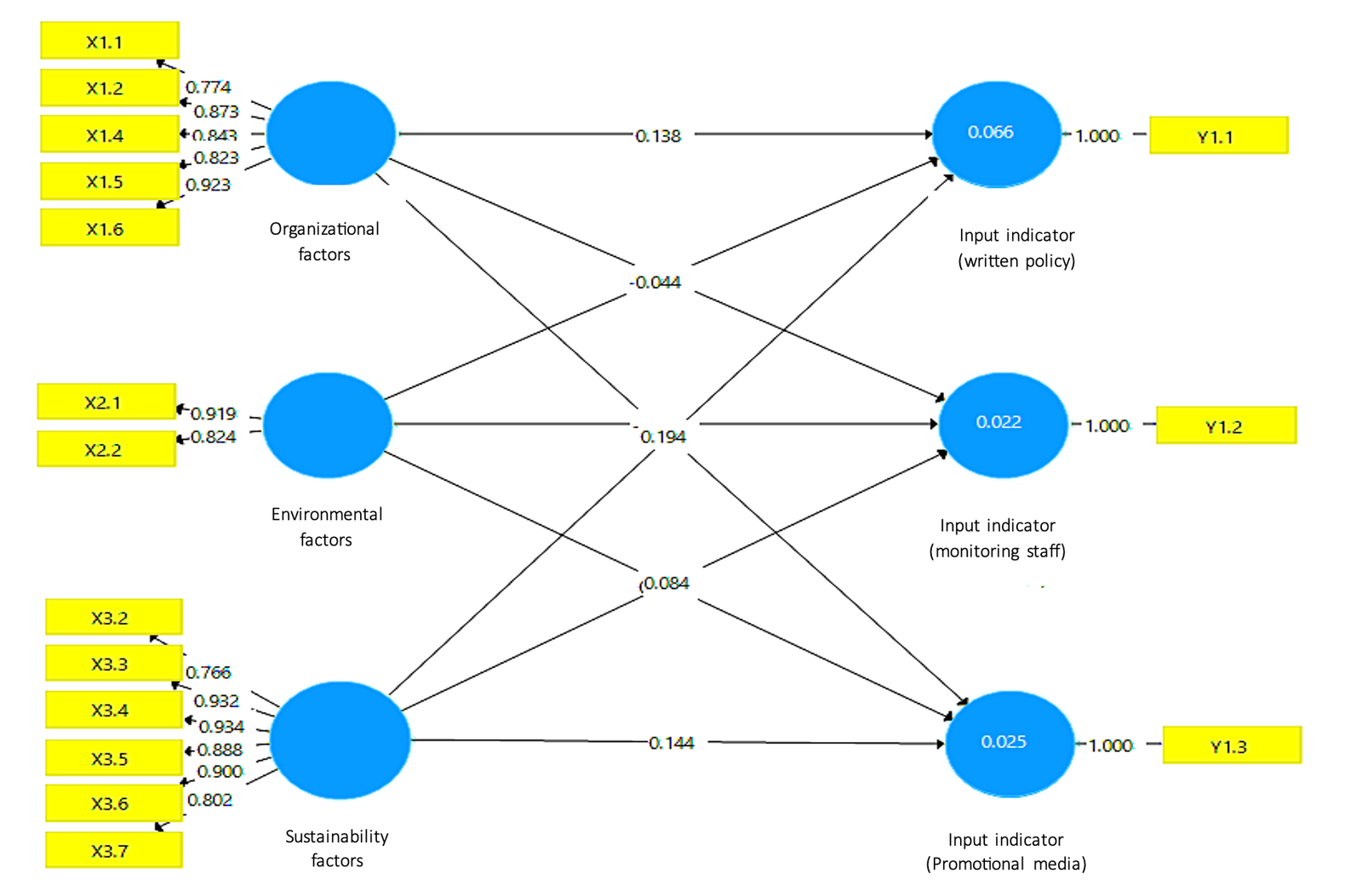
The implementation of smoke-free policies in healthcare facilities represents a critical public health strategy; however, maintaining sustainable compliance remains a challenge globally. While healthcare institutions are expected to exemplify tobacco control measures, the effectiveness of smoke-free policies depends on multiple factors at the institutional and governmental levels. This study aimed to examine the influence of organizational, environmental, and sustainability factors on input indicators for smoke-free area policy implementation in healthcare facilities in Makassar, Indonesia. A quantitative correlational study was conducted across seven healthcare facilities that provide inpatient services. Using random cluster sampling, 232 healthcare workers were selected from a population of 736. Path analysis was employed to evaluate causal relationships between independent variables (organizational, environmental, and sustainability factors) and dependent variables (input indicators, including written policies, monitoring personnel, and promotional media). Data were collected through validated questionnaires and analyzed via structural equation modeling. Path analysis revealed that sustainability factors significantly influenced input indicators, particularly written policies (t statistic = 2.592, p<0.05, β=0.194). Key sustainability components, including funding stability, partnerships, organizational capacity, program evaluation, adaptation, and strategic planning, have demonstrated positive effects on policy implementation. Organizational and environmental factors had no significant impact on the input indicators. Sustainability factors emerged as crucial determinants for the successful implementation of smoke-free policies in healthcare facilities in Makassar city. Future research should investigate the barriers to policy implementation and explore additional input indicators to increase the effectiveness of smoke-free policies.
Downloads
References
Reitsma MB, Kendrick PJ, Ababneh E, Abbafati C, Abbasi-Kangevari M, Abdoli A, et al. Spatial, temporal, and demographic patterns in prevalence of smoking tobacco use and attributable disease burden in 204 countries and territories, 1990–2019: a systematic analysis from the global burden of disease study 2019. Lancet 2021;397:2337–60. https://doi.org/10.1016/s0140-6736(21)01169-7.
O’Connor RJ, Cummings KM. Tobacco harm minimization. International Encyclopedia of Public Health. 1st ed., Netherlands: Elsevier B.V.; 2017, p. 169–77. https://doi.org/10.1016/b978-0-12-803678-5.00465-3.
West R. Tobacco smoking: Health impact, prevalence, correlates and interventions. Psychol Health 2017;32:1018–36. https://doi.org/10.1080/08870446.2017.1325890.
Perez-Warnisher MT, De Miguel MPC, Seijo LM. Tobacco use worldwide: legislative efforts to curb consumption. Ann Glob Health 2018;84:571. https://doi.org/10.29024/aogh.2362.
Eljatin DS, Akbar Eljatin MR, Adnyana IMDM, Hutagalung MBZ, Setyawan MF. Excessive use of Nipah leaf membrane cigarettes increases the severity of spontaneous pneumothorax: A case study from Jambi, Indonesia. J Pharm Health Res 2023;4:9–13. https://doi.org/10.47065/jharma.v4i1.2820.
Alderwick H, Hutchings A, Briggs A, Mays N. The impacts of collaboration between local health care and non-health care organizations and factors shaping how they work: a systematic review of reviews. BMC Public Health 2021;21:753. https://doi.org/10.1186/s12889-021-10630-1.
Nadhiroh SR, Djokosujono K, Utari DM. Socioeconomic characteristics, paternal smoking and secondhand tobacco smoke exposure among infants in Jakarta, Indonesia. Tob Induc Dis 2020;18. https://doi.org/10.18332/tid/120077.
CDC, WHO, RTI International. GATS (Global Adult Tobacco Survey) comparison fact sheet, Indonesia 2011 and 2021. World Health Organization. 2022. Available from: https://stacks.cdc.gov/view/cdc/148399
CDC, WHO, RTI International. Global Adult Tobacco Survey Fact Sheet Indonesia 2021. Ministry of Health, Republic of Indonesia 2022. Available from: https://cdn.who.int/media/docs/default-source/ncds/ncd-surveillance/data-reporting/indonesia/indonesia-national-2021-factsheet.pdf?sfvrsn=53eac4fd_1
Astuti PAS, Assunta M, Freeman B. Why is tobacco control progress in Indonesia stalled? - A qualitative analysis of interviews with tobacco control experts. BMC Public Health 2020;20:1–12. https://doi.org/10.1186/s12889-020-08640-6/tables/2.
Ahsan A, Afin R, Amalia N, Hindriyani M, Jacinda AR, Kramer E. FCTC ratification, smoking prevalence, and GDP per capita: lessons for Indonesia and the rest of the world. Global Health 2022;18:1–6. https://doi.org/10.1186/s12992-022-00810-y/tables/4.
Hoe C, Kennedy RD, Spires M, Tamplin S, Cohen JE. Improving the implementation of tobacco control policies in low-and middle-income countries: a proposed framework. BMJ Glob Health 2019;4:e002078. https://doi.org/10.1136/bmjgh-2019-002078.
Catalano MA, Gilleskie DB. Impacts of local public smoking bans on smoking behaviors and tobacco smoke exposure. Health Econ 2021;30:1719. https://doi.org/10.1002/hec.4280.
Martin K, Dono J, Sharplin G, Bowden J, Miller C. Staff and patient perspectives of a smoke-free health services policy in South Australia: A state-wide implementation. Health Policy (New York) 2017;121:895–902. https://doi.org/10.1016/j.healthpol.2017.06.003.
Kramer E, Masduki M, Rosemary R, Maryani E, Nurhajati L, Redjeki AMS. How do national laws filter down to the local? tobacco control regulations and smoke free areas in a decentralised Indonesia. J Curr Southeast Asian aff 2023;42:216–41. https://doi.org/10.1177/18681034231185159.
Asyary A, Veruswati M, Arianie CP, Diah Ratih TS, Hamzah A. Prevalence of smoke-free zone compliance among schools in indonesia: a nationwide representative survey. Asian Pac J Cancer Prev 2021;22:359. https://doi.org/10.31557/apjcp.2021.22.2.359.
Idris. Perokok di Makassar Perempuan Capai 48%, Anak-anak 91%. Online24jam 2020. Available from: https://online24jam.com/2020/01/30/perokok-di-makassar-perempuan-capai-48-persen-anak-anak-91-persen-ini-faktanya/.
Alwy Arifin M, Sirajuddin S, Susanti A, Inayah Ismaniar N. The implementationof non-smoking area policy in Hospital of Islam Faisal Makassar. Eur J Mol Clin Med 2021;08:2021. https://repository.unhas.ac.id/id/eprint/9996/
Boderie NW, Sheikh A, Lo E, Sheikh A, Burdorf A, van Lenthe FJ, et al. Public support for smoke-free policies in outdoor areas and (semi-)private places: a systematic review and meta-analysis. EClinicalMedicine 2023;59:101982. https://doi.org/10.1016/j.eclinm.2023.101982.
Gichuki JW, Opiyo R, Mugyenyi P, Namusisi K. Healthcare providers’ level of involvement in provision of smoking cessation interventions in public health facilities in Kenya. J Public Health Afr 2015;6:62–7. https://doi.org/10.4081/JPHIA.2015.523.
Pollack Porter KM, Rutkow L, McGinty EE. The importance of policy change for addressing public health problems. Public Health Rep 2018;133:9S-14S. https://doi.org/10.1177/0033354918788880.
Farrelly MC, Chaloupka FJ, Berg CJ, Emery SL, Henriksen L, Ling P, et al. Taking stock of tobacco control program and policy science and impact in the United States. J Addict Behav Ther 2017;1. https://pmc.ncbi.nlm.nih.gov/articles/PMC6124688/
Luck KE, Doucet S. What are the perceptions, experiences, and behaviors of health care providers after implementation of a comprehensive smoke-free hospital policy? Glob Qual Nurs Res 2018;5: 2333393618756770. https://doi.org/10.1177/2333393618756770
Paulus AY, Sulaeman, Mayasari AC, Ayu JD, Musniati N, Sari MP, et al. Biostatistika Epidemiologi. 1st ed. Bandung: CV. Media Sains Indonesia; 2023.
Adnyana IMDM. Populasi dan Sampel. In: Darwin M, editor. Metode Penelitian Pendekatan Kuantitatif. 1st ed., Bandung: CV. Media Sains Indonesia; 2021, p. 103–16.
Kumar M, Vinati. Stakeholder engagement and collaboration in health policy implementation: lessons learned. South East Eur J Public Health 2024;23:104–19. https://doi.org/10.52710/SEEJPH.491.
Ansell C, Sørensen E, Torfing J. Improving policy implementation through collaborative policymaking. Policy Polit 2017;45:467–86. https://doi.org/10.1332/030557317X14972799760260.
Folkerth M, Adcock K, Singler M, Bishop E. Citizen science: A new approach to smoke-free policy advocacy. Health Promot Pract 2020;21:82S-88S. https://doi.org/10.1177/1524839919883586.
Lee S, Park EY. Examining aid fragmentation and collaboration opportunities in Cambodia’s health sector. Global Health 2024;20:62. https://doi.org/10.1186/s12992-024-01063-7.
Kruk ME, Gage AD, Arsenault C, Jordan K, Leslie HH, Roder-DeWan S, et al. High-quality health systems in the Sustainable Development Goals era: time for a revolution. Lancet Glob Health 2018;6:e1196–252. https://doi.org/10.1016/S2214-109X(18)30386-3.
Gasco-Hernandez M, Nasi G, Cucciniello M, Hiedemann AM. The role of organizational capacity to foster digital transformation in local governments: The case of three European smart cities. Urban Governance 2022;2:236–46. https://doi.org/10.1016/J.UGJ.2022.09.005.
Bryan TK. Toward a contingency model for the relationship between capacity and effectiveness in nonprofit organizations. Nonprofit Volunt Sect Q 2018;48:885–97. https://doi.org/10.1177/0899764018815617
Meilissa Y, Nugroho D, Luntungan NN, Dartanto T. The 2019 economic cost of smoking-attributable diseases in Indonesia. Tob Control 2022;31:s133–9. https://doi.org/10.1136/tobaccocontrol-2021-056890.
Septiono W, Kuipers MAG, Ng N, Kunst AE. Progress of smoke-free policy adoption at district level in Indonesia: A policy diffusion study. Int J Drug Policy 2019;71:93–102. https://doi.org/10.1016/j.drugpo.2019.06.015.
Teed JA, Robichaud MO, Duren M, Gouda HN, Kennedy RD. State of the literature discussing smoke-free policies globally: A narrative review. Tob Induc Dis 2024;22:1–17. https://doi.org/10.18332/tid/174781.
Akter S, Islam MdR, Rahman MdM, Rouyard T, Nsashiyi RS, Hossain F, et al. Evaluation of Population-Level Tobacco Control Interventions and Health Outcomes. JAMA Netw Open 2023;6:e2322341. https://doi.org/10.1001/jamanetworkopen.2023.22341.
Al-Humaiqani MM, Al-Ghamdi SG. The built environment resilience qualities to climate change impact: Concepts, frameworks, and directions for future research. Sustain Cities Soc 2022;80:103797. https://doi.org/10.1016/j.scs.2022.103797.
Downloads
Published
How to Cite
Issue
Section
License
Copyright (c) 2025 Nur Inayah Ismaniar, Wahyudin Wahyudin , Faradillah Paratama (Author)

This work is licensed under a Creative Commons Attribution-NonCommercial-NoDerivatives 4.0 International License.
This license enables reusers to copy and distribute the material in any medium or format in unadapted form only, for noncommercial purposes only, and only so long as attribution is given to the creator.